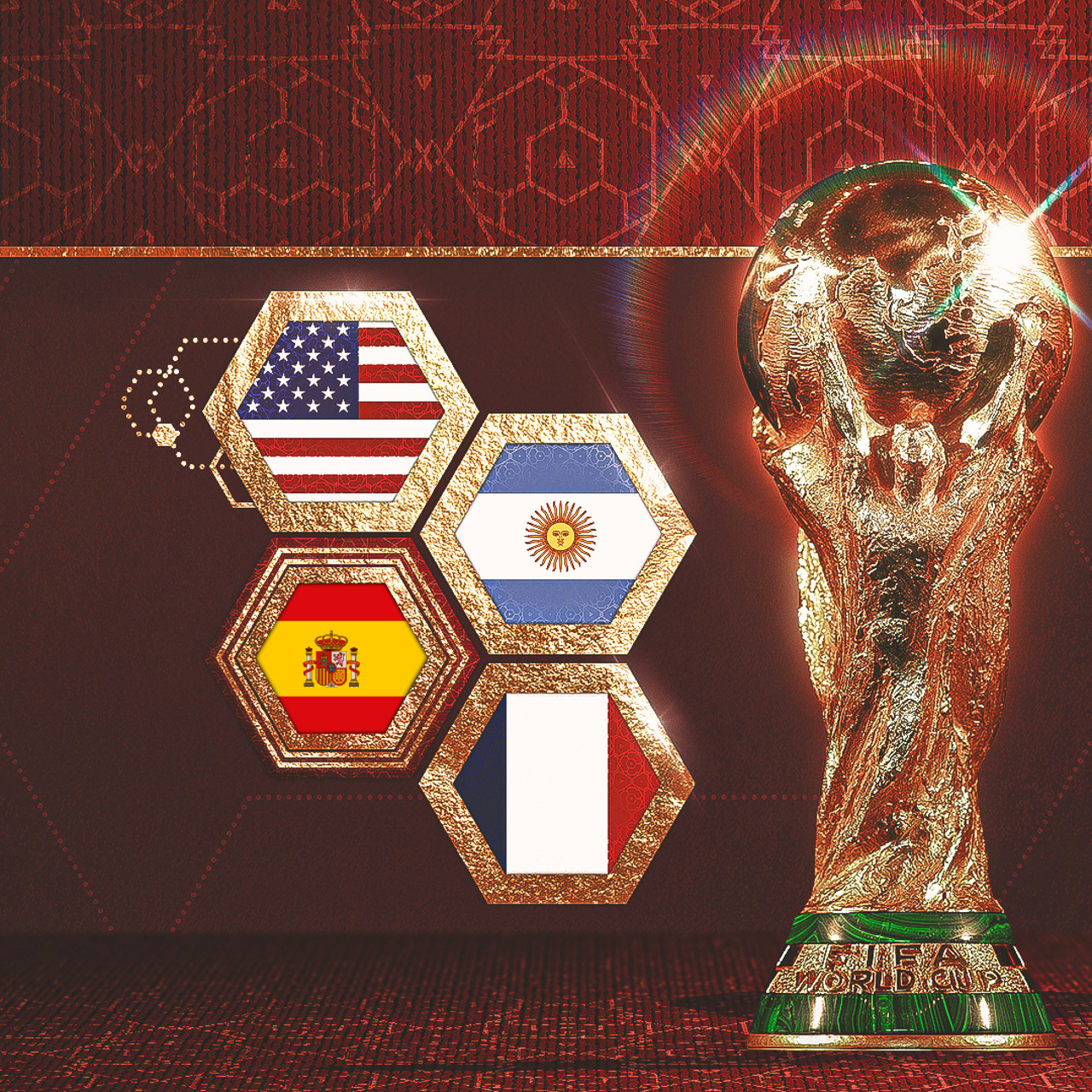
The 2026 FIFA World Cup is shaping up to be the most unpredictable World Cup in modern history. With the tournament expanding to 48 teams, spreading across three massive host nations; the USA, Mexico, and Canada, and introducing a longer, more chaotic knockout path, the race for the trophy has never been wider open.
More teams mean more upsets. More travel means more surprises. More tactical evolution means traditional giants are no longer guaranteed safe passage. And as the football world reloads with new golden generations, one question is louder than ever: Who are the TRUE favourites to win the 2026 World Cup? From established powerhouses chasing redemption, to dark horses built on fearless youth, to nations entering their peak cycles at the perfect time.
This power ranking breaks down the contenders based on squad depth, recent performance, tactical identity, coaching direction, and star power, giving you the clearest early picture of where every major nation stands heading into the biggest World Cup of all time. Let’s dive into the rankings and see who really has the firepower to conquer 2026.
1. Brazil 🇧🇷 — The Undisputed No.1 Contender
The Brazil National Team would be entering the 2026 World Cup with a squad that feels built for a modern tournament. For the first time in over a decade, they are not relying on a single superstar to carry them, instead, they have an entire generation reaching their peak at the same time. This is the deepest, most tactically flexible, and most talent-loaded Brazilian squad since the 2002 champions.
Why They Can Win
Brazil’s new identity is built on pace, positional fluidity, and elite 1v1 specialists. They have multiple attackers capable of breaking tight defensive blocks, something that has hurt Brazil in past tournaments. Their midfield has evolved from traditional flair to include modern workhorses who press, recover, and progress play with intelligence.
The data backs their dominance:
- Between 2022–2024, Brazil consistently ranked top 5 globally in xG (expected goals) and attacking transitions.
- They now produce more high-value scoring chances without depending on Neymar.
- Their U17 and U20 teams are among the strongest in the world, feeding even more depth into 2026.
Key Players
- Vinícius Júnior — arguably the best winger on the planet, entering his prime.
- Rodrygo — versatile, clutch, and tactically brilliant.
- Endrick — the generational No.9 talent they’ve lacked since Ronaldo.
- Bruno Guimarães — the midfield brain with elite passing range.
- Marquinhos — leadership + defensive experience.
- Gabriel Martinelli — explosive depth that gives them different attacking profiles.
Why They’re the Favourites
- They have the best attacking depth in international football.
No nation can match Brazil’s combination of speed, creativity, finishing, and dribbling. - Their young core is already performing at elite club level.
Most of their stars start for Real Madrid, Arsenal, Liverpool, Newcastle, and other top clubs. - They’ve modernised tactically. This Brazil team presses high, transitions fast, and builds out from the back with confidence — the exact profile of recent champions (Spain 2010, Germany 2014, France 2018).
- Psychological hunger : Brazil hasn’t won the World Cup since 2002. This generation is obsessed with ending that drought.
The Big Question
Can they stay consistent defensively over seven matches?
Brazil’s attack will win them games, but World Cups are often decided by a single defensive lapse. If the backline holds firm, especially against Europe’s physical sides, Brazil have everything needed to lift their 6th World Cup.
2. France 🇫🇷 — The Most Complete Squad in World Football
If Brazil are the No.1 contenders, then French National Team is 1B, not 2. No team in the world has France’s combination of depth, physicality, experience, youth talent, and tactical versatility. Since 2016, France have reached three major tournament finals, winning one World Cup and narrowly losing another in a penalty shootout. Their consistency at the highest level is unmatched.
The scary part? Their 2026 squad will be even stronger.
Why They Can Win
France’s talent pipeline is absurd. Every position has at least two world-class options, and several positions have three. Their young players aren’t just prospects, they are already starring for elite clubs across Europe.
They combine tournament experience, Elite athleticism, Modern pressing structure, Powerful squad rotation and Players who can win games individually. France would be entering the 2026 with arguably the best bench in world football, a critical advantage in a 48-team tournament with more matches and fatigue.
Key Players (Core + Rising Stars)
Kylian Mbappé — The most dangerous forward alive. A one-man tactical nightmare.
Eduardo Camavinga — World-class versatility; can dominate midfield or full-back.
Aurélien Tchouaméni — The defensive anchor; elite ball-winner with progressive passing.
Antoine Griezmann — The glue; creativity, intelligence, leadership.
William Saliba — The future of their defence; calm, elite positioning, unplayable 1v1.
Ousmane Dembélé — Chaos factor; stretches defences and breaks shape.
Randal Kolo Muani / Marcus Thuram / Barcola — Ridiculous squad depth in attack.
Youssouf Fofana / Zaire-Emery — The new generation is already knocking on the door.
Why They’re Genuine Title Favourites
- The strongest midfield engine in international football; Tchouaméni + Camavinga + Zaire-Emery is a terrifying blend of power, technique, and maturity.
- A fully modern tactical identity. France can switch comfortably between: high press, deep block, counterattacking, possession-dominant play or mixed transitional football
- They have the world’s ultimate trump card: Mbappé. In a tight knockout game, no one shifts momentum like him.
- Their defensive evolution is elite. France now has Saliba, Upamecano, Konaté, and Koundé, a wall no nation can match in depth or quality.
- Consistency at big tournaments : Final in 2016, Champions in 2018, Final in 2022, Knockout regulars since 2014
No nation has been more dominant in the last decade.
The Big Question
Post-Griezmann leadership, who becomes the midfield creator? His influence is massive. France’s biggest challenge is replacing his vision, discipline, and tactical intelligence. If they solve that, and they likely will, they are almost unbeatable.
3. Argentina 🇦🇷 – Messi or No Messi, the Champions Are Still a Machine
The world expected Argentina’s dominance to end once Lionel Messi stepped back. Instead, something remarkable happened, the Argentina National Team became a system, not a superstar dependency.
Winning the 2021 Copa América, the 2022 Finalissima, and the 2022 World Cup wasn’t an accident, it was the birth of a new football identity. Scaloni built a culture of intensity, humility, and tactical clarity that continues to thrive with or without Messi on the pitch. In 2026, Argentina would be going not as a fading champion, but as a fully evolved powerhouse.
Why They Can Win
Argentina now have what they lacked for nearly 15 years; structure, balance, and a generation that plays the same football philosophy from back to front. This team presses as a unit, attacks as a unit, and suffers as a unit. And most importantly, they have rediscovered the winning mentality that carried them through extra-time battles against Netherlands and France in 2022.
Even without Messi playing every minute, Argentina remains cohesive, organized, battle-tested, mentally elite and extremely hard to break down. In modern football, SYSTEM beats STAR POWER and Argentina finally have both.
Key Players (The New Core)
Julián Álvarez — The engine of the attack; movement, intensity, finishing.
Lautaro Martínez — A mature, cold-blooded striker now entering his prime.
Enzo Fernández — Tempo-setter with world-class passing and control.
Alexis Mac Allister — Intelligence + versatility; the link between lines.
Lisandro Martínez — The warrior; world-class in duels and ball progression.
Cristian Romero — Defensive leader with elite aggression and timing.
Thiago Almada / Garnacho / Nicolás González — Rising threats who add fire.
Strengths That Make Them Contenders
- A complete defensive structure : Argentina now concede few goals because the whole team presses, blocks space, and protects their centre-backs.
- A balanced midfield trio with perfect chemistry : Enzo + Mac Allister + De Paul form one of the most synchronized midfields in international football.
- Championship resilience : They don’t panic. They don’t break. They win ugly, pretty, and everything in between.
- Attackers who fit the system : Álvarez and Lautaro have completely replaced the “wait for Messi to save us” era.
- A coach who evolved them : Scaloni built a culture; leadership, intensity, humility.
The Big Question
Can Argentina maintain the same emotional and psychological edge without Messi on the field every minute? He is more than a player, he’s an aura, a shield, and the emotional spine of the team, But the squad is experienced enough now to stand on its own.
4. England 🏴 — Their Golden Chance
For decades, England has carried the weight of expectation. In 2026, that pressure transforms into opportunity. This is the England National Team’s most naturally gifted generation since 1966, but unlike previous “Golden Generations,” this one actually fits together. They have balance. They have chemistry. And they finally have multiple match-winners capable of changing a game on their own.
With most of their stars entering their peak years (ages 23–27), the 2026 World Cup lines up perfectly with England’s talent timeline. If there was ever a moment for football to “come home,” it’s now.
Why They Can Win
England will be entering 2026 with a squad stacked from defense to attack. This is a team with elite athleticism, creativity, ball progression, and for the first time; multiple world-class midfielders capable of dominating the biggest games.
They have a generational superstar in Jude Bellingham, one of the world’s most consistent wingers in Bukayo Saka, creative genius in Phil Foden, a midfield anchor in Declan Rice and a deep supporting cast (Gordon, Palmer, Mainoo, Watkins, Trent, etc.) 2026 is the first tournament where England are not just “talented”, they’re complete.
Key Players
Jude Bellingham — The face of the team; the mentality monster; a Ballon d’Or-level leader.
Bukayo Saka — Reliable, consistent, and decisive in big moments.
Phil Foden — The magician; vision and technique that can unlock any defense.
Declan Rice — The stabilizer; England’s midfield backbone.
Harry Kane (if active) — Experience, leadership, and elite finishing. Even if not at his peak, his presence matters.
Cole Palmer / Kobbie Mainoo / Trent Alexander-Arnold — Tactical weapons that add versatility.
Strengths
- A young world-class core entering peak age: Most title-winning national teams peak around ages 24–28. England’s best players hit that window perfectly in 2026.
- Multiple creative playmakers : Foden, Bellingham, Palmer, Maddison, England now have the creativity they lacked for years.
- Explosive wide players : Saka, Gordon, Rashford; pace, 1v1 threat, goals.
- Bench depth : England can bring on game-changers, something most nations can’t match.
- Set-piece dominance : Trent + Trippier + Rice = elite dead-ball threat.
Weakness
Tactical rigidity and knockout-stage fear, England often fall into; predictable build-up, slow tempo, overly cautious in big moments and psychological collapses in pressure situations. The squad is good enough to win, but the question is: Will the manager let them?
5. Spain 🇪🇸 — The Silent Superpower Reborn
The Spain National Team may not shout the loudest, but make no mistake: they are back, after nearly a decade of rebuilding post-2010 glory, La Roja enter the 2026 World Cup with a revitalized identity built around youth, technique, structure, and possession dominance.
Their UEFA Nations League triumph and strong Euro 2024 performances proved one thing clearly: Spain are no longer a team in transition, they are a contender again. This is a squad loaded with some of the best young midfielders and attackers in the world, and a generation that plays the classic Spanish style with modern aggression. If they peak at the right time, Spain could quietly overwhelm the entire tournament.
Why They Can Win
Spain’s biggest strength is their system. Unlike most national teams that rely heavily on individuals, Spain’s foundation is built on synchronized pressing, intelligent positional play, suffocating ball control, and wave-after-wave chance creation. They dominate games the same way they dominated an entire era from 2008–2012, but with more speed and verticality this time.
Their 2026 squad blends world-class youngsters, elite midfield control, and smart coaching, making them one of the most tactically cohesive teams heading to North America.
Key Players
Pedri — Their midfield nucleus; press-resistant, intelligent, elite vision.
Gavi — Heart of the team; aggression, energy, and unmatched intensity.
Lamine Yamal — One of the most gifted young wingers in football history.
Nico Williams — Explosive pace, dribbling, and direct goal threat.
Rodri — The best defensive midfielder in the world; their anchor.
Aymeric Laporte / Pau Torres — Ball-playing defenders suited to Spain’s system.
Álvaro Morata / Ansu Fati / Dani Olmo — Reliable contributors depending on form.
Strengths
- Best midfield unit in the world : No nation controls tempo like Spain.
- Elite ball dominance and pressing structure : Opponents rarely touch the ball long enough to hurt them.
- Young, fast, and technical wide players : Yamal, Williams, Olmo; a nightmare for defenses.
- Strong identity : Spain always “looks like Spain,” no matter the opponent.
- Tournament consistency : They never bow out easily; they will always give you a game.
Weakness
Spain creates dozens of chances but lacks a guaranteed elite finisher. This means they dominate without scoring, suffering unnecessary scares and getting punished by more clinical teams. If they find a striker who catches form (Morata, Fati, or a younger breakout star), they instantly become top-3 favourites.
6. Portugal 🇵🇹 — The Most Complete Squad They’ve Ever Had
The Portugal National Team would be entering the 2026 World Cup with arguably the strongest and deepest squad in their history, even stronger than the 2016 Euro-winning team and the Ronaldo-led golden years. This is a team overflowing with world-class talent across every department, from elite wingers, top notch midfielders, solid defenders, tactical elite full-backs, multiple goal scorers and a winning mindset.They’ve transformed from a one-man show into one of the most balanced and modern national teams in the world. Whether or not Cristiano Ronaldo plays in 2026, Portugal have a squad built to challenge for the title.
With technical ability, tactical intelligence, and squad depth that rivals France and Brazil, this Portugal can beat anyone.
Why They Can Win
Portugal’s strength is in their completeness, they’re one of the rare teams with pace, creativity, physicality, technical brilliance, tactical versatility and match-winners everywhere. They can play possession football, hit on the counter, press aggressively, or sit deep and strike late. Few teams in the world can match their adaptability.
Key Players
Bruno Fernandes — Elite creator; controls tempo, chance machine.
Bernardo Silva — Tactical genius; glue of the midfield.
Rafael Leão — Devastating pace and 1v1 monster.
João Félix — Creativity and flair; can unlock tight defenses.
Diogo Jota — Clinical, mobile, big-game mentality.
Gonçalo Ramos — Strong No.9 presence; showed glimpses in 2022.
Rúben Dias — One of the best defenders in the world.
Cristiano Ronaldo (if present) – Even at 41, his mentality, leadership, and penalty-box instincts still demand respect.
Strengths
- Top-5 squad depth in the world : Quality backups in almost every position.
- Multiple sources of goals : They don’t rely on a single striker.
- Elite full-backs for modern football : Cancelo & Mendes give width, creativity, and unpredictability.
- Experienced core + young breakout stars : Perfect balance for tournament play.
- A new tactical identity : More fluid, more dynamic, less restrictive than previous years.
Weakness
Portugal sometimes:
- struggle to control games against high-pressing teams
- overcomplicate attacks
- lose defensive focus late in matches
- rely on individual brilliance instead of structure
Their biggest question heading into 2026 is; Can they find consistency when it matters most?
7. USA 🇺🇸 — Home Advantage + Golden Generation
The United States National Team would be stepping into the 2026 World Cup with something they’ve never had before, a complete golden generation entering peak age on home soil, backed by the most passionate, sports-crazy country in the world. This isn’t the old, predictable USA team, this is a fast, technical, tactically modern squad built around European-based stars, elite athleticism, and a new fearless mentality. With the tournament hosted across 16 cities in the USA, Mexico, and Canada, the USMNT will enjoy; familiar stadiums, no jet lag, massive fan support, maximum comfort and zero environmental shock.
In World Cups, home advantage is real and in 2026, it could push the USA deeper than ever before. The world sees them as underdogs. But the truth? They’re a sleeping giant that might finally wake up.
Why They Can Shock the World
- Home Advantage = X-Factor : Every World Cup host since 1990 has performed above expectations. The USA will play in front of 60,000–80,000 fans every match.
- Golden Generation Entering Peak Years : Most of the squad will be 24–28, the perfect age range for a major tournament.
- European Experience : For the first time ever, America’s top players come from Chelsea, AC Milan, Juventus, Dortmund, and Valencia, not MLS-only squads.
- Explosive, Modern Football : High pressing, Fast transitions and Flexible formations. The USA plays like a Champions League-era team now, not the scrappy 2002 side.
- Fearless Mindset : They don’t freeze against big nations anymore, ask England (0–0 in 2022).
Players to Watch
Christian Pulisic — The talisman. Creative, fast, clutch in big games.
Weston McKennie — Physical, relentless, engine of the midfield.
Folarin Balogun — A natural striker the USA desperately needed.
Giovanni Reyna — Elite playmaker; vision and technique beyond his age.
Yunus Musah — Powerful dribbler who breaks pressure like a top No. 8.
Timothy Weah — Pace, width, and versatility.
Antonee Robinson — One of the best modern full-backs in CONCACAF.
Matt Turner — Big-shot goalkeeper with tournament temperament.
Prediction
A quarterfinal run is realistic.
A semifinal run is possible with the right bracket.
And if they hit form early?
2026 could produce the biggest American sports story since 1980’s Miracle on Ice.
Conclusion: The Road to World Cup 2026 Is Set to Rewrite Football History
World Cup 2026 is shaping up to be the most unpredictable, talent-packed, and goal-heavy tournament we’ve ever seen. From tactical revolutions to emerging wonderkids, from expanded host nations to record-breaking stadium atmospheres, every indicator points toward a World Cup that will define a new era of global football.
Traditional giants like France, Brazil, and Argentina remain the teams to beat, loaded with depth, elite coaching, and world-class players at their physical peak. But this tournament feels different. The rise of new contenders like Portugal, Japan, USA, Morocco, and the Netherlands signals a shift: football’s balance of power is spreading, and the gap between top nations and hungry challengers has never been smaller.
With more teams, more games, and more moments of magic waiting to happen, the stage is set for storylines we’ve never seen before:
▪️ A breakout superstar carrying his nation.
▪️ An African or Asian side shocking the world.
▪️ A Golden Boot race that goes down to the wire.
▪️ A host nation riding momentum into deep rounds.
Football is changing, faster, bolder, and more global than ever. And World Cup 2026 won’t just crown a champion; it will reveal the future of the sport. One thing is certain: history will be made. Whether a powerhouse lifts the trophy or a dark horse shakes the world, this tournament promises unforgettable drama.
Bring on 2026. The world is ready.