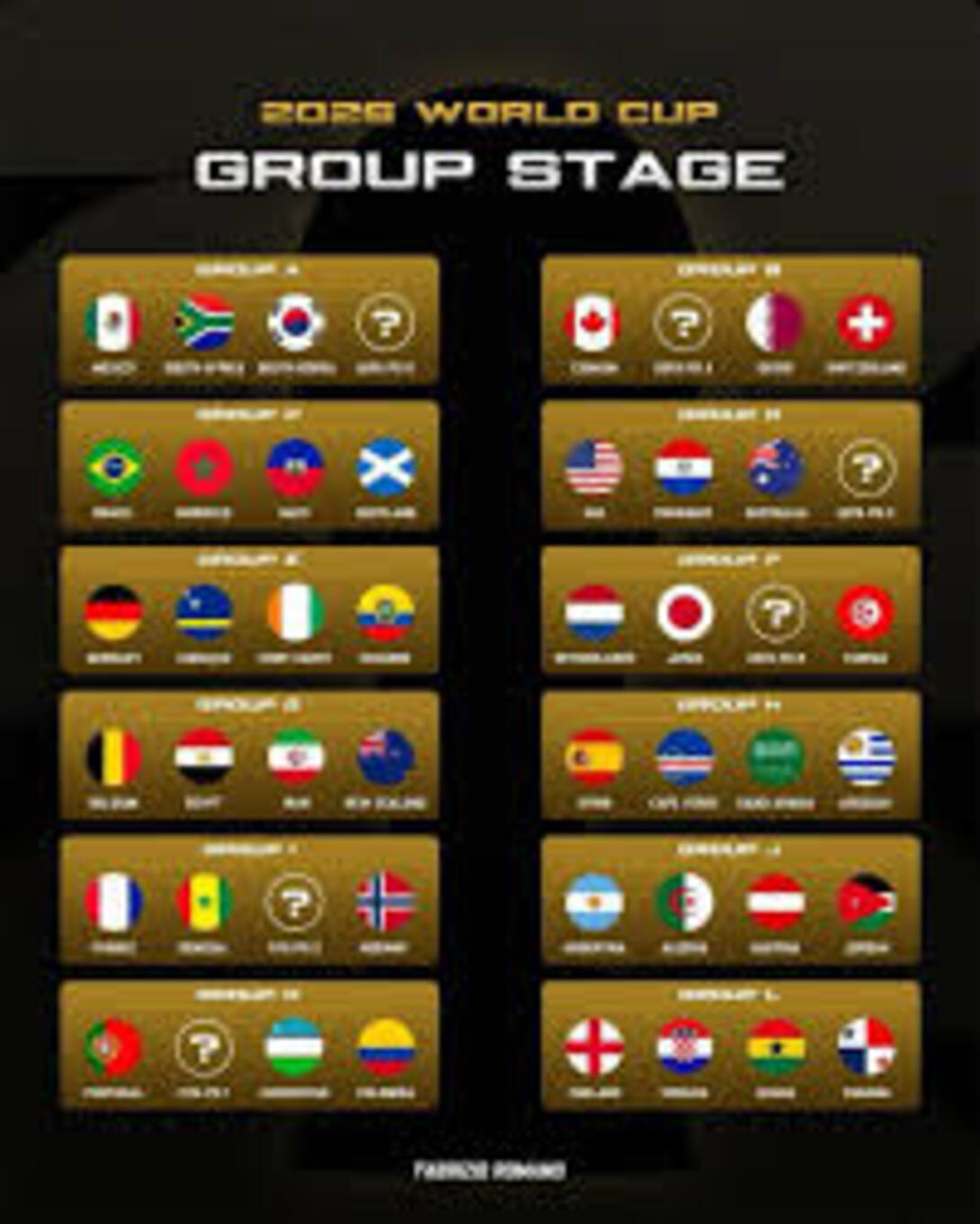
The wait is finally over. At the draw held on 5 December 2025 in Washington, D.C., the groups for the 2026 FIFA World Cup were officially revealed, setting the stage for what promises to be the most dramatic, unpredictable, and global edition of the tournament ever.
With 48 teams now in the mix, spread across the United States, Mexico, and Canada, the group stage is wide open. The draw has already sparked excitement, hope and a few nerves around the world.
Below is the full breakdown of all 12 groups (A–L), the teams involved (including placeholders for playoff spots), and key storylines to watch heading into 2026. This guide breaks down every group, the teams, the big storylines, and early predictions for the biggest World Cup in history.
FULL GROUP STAGE DRAW — BREAKDOWN & ANALYSIS
Below is the official layout of all the teams placed into each group for the 2026 World Cup:
Group A
Group A kicks off the 2026 World Cup with a fascinating mix of styles: the energy and home support of Mexico, the revival spirit of South Africa, the discipline of South Korea, and a yet-to-be-determined European qualifier. This is a balanced group with no outright favourite, meaning every game will carry real qualification weight. Expect intense clashes, contrasting football philosophies, and a genuine battle for the top two spots.
🇲🇽 Mexico (Co-Host) : Mexico thrives on home energy, and with the tournament returning to North America, El Tri will expect to dominate the atmosphere in every stadium they play. Known for their technical midfield play, quick combination football, and fearless pressing style, Mexico always perform well in the group stage. Their biggest question is consistency in front of goal, but with home support behind them, they become a completely different beast.
🇿🇦 South Africa : South Africa return to the global stage with renewed identity, pace, and improved tactical structure. The Bafana Bafana play energetic football built on speed, counter-attacks, and unpredictable movement in the final third. Their athleticism makes them dangerous for any opponent, especially in open games. If they find rhythm early, they can shock bigger teams.
🇰🇷 South Korea: One of Asia’s most consistent World Cup performers, South Korea bring discipline, tactical organization, and strong European-based talent. They excel in structured pressing, controlled build-up play, and intelligent movement. Their work rate makes them one of the toughest teams to break down. If they bring efficiency in attack, they could easily top the group.
🇪🇺 UEFA Playoff Winner D (TBD): This final slot adds a major element of unpredictability. Whoever qualifies from the European playoffs will arrive with momentum and competitive sharpness. These teams tend to be defensively strong and tactically drilled, they’re used to pressure and often perform above expectations in tournaments. Their identity will matter greatly, but one thing is certain: they won’t be pushovers.
Quick Analysis
Group A is wide open, arguably one of the most competitive and evenly matched groups of the entire draw.
- Mexico: boosted by home advantage and crowd pressure
- South Korea: the most tactically reliable team in the group
- South Africa: athletic and dangerous, capable of surprising anyone
- UEFA PO D: the unpredictable factor that can disrupt the expected narrative
- Favourites to advance: Mexico & South Korea
- Dark horse: South Africa (especially if the UEFA qualifier is weaker)
Every team has a realistic route to the knockout stage. The battle for 1st and 2nd could easily go down to the final matchday.
Group B
This group mixes host advantage, European sturdiness, Middle East grit, and a wildcard, creating a balanced, unpredictable pool of four very different teams.
🇨🇦 Canada (Hosts) : This is the home nation’s biggest football moment; a chance to shine on the world stage with home fans, home stadiums, and familiar turf. Canada has steadily improved in recent years and now brings a squad that combines younger talent with growing international experience. Playing at home gives them more than just comfort: it gives them momentum, passion, and a belief that they can surprise many. With Swiss organization, Qatari discipline, and a playoff wildcard, Canada will need maximum focus, but home advantage alone could push them over the line to a second-round berth.
🇨🇭 Switzerland : Switzerland are a model of consistency and tactical organisation in every major tournament. They’ve qualified regularly and know how to navigate group stages without panic. With a balanced defence, disciplined midfield, and players used to pressure matches in European leagues, the Swiss remain dangerous, especially against sides that might underestimate them. Their experience and structure give them a real shot at advancing, even if they aren’t the flashiest team in the group.
🇶🇦 Qatar : Qatar returns to the World Cup stage, this time not as hosts, but as a qualified competitor. Though often underestimated, Qatar’s qualification shows resilience. Their domestic league experience, defensive discipline, and growing sense of purpose make them dark-horse material for upsets. In a group where favourites might take time to adjust, Qatar could exploit any early complacency.
UEFA Play-off Winner A (TBD) : One spot in this group will go to the winner of a European playoff, likely Italy, Wales, Northern Ireland, or Bosnia & Herzegovina. Once determined, this team will bring European tactical nous, unpredictability, and a wildcard factor that could destabilize any expectations. Depending on who qualifies, this could shift Group B into a far more competitive pool, or leave Canada as the clear dark horse.
Quick Analysis
- Home Advantage vs. Consistency: Canada’s home crowd could be decisive, but will their relative inexperience hold up against European and playoff teams?
- Swiss Stability: Switzerland may not be flashy, but their match-experience under pressure could help them sneak through.
- Qatar’s Upset Potential: Watch out if any “overconfident favourite” treats them lightly, they might bite.
- Wildcard Impact: The unknown factor of the play-off winner adds unpredictability. A strong European qualifier could turn this group into a toss-up from top to bottom.
- Target for Dark Horses: If Canada and Qatar make early waves, Group B becomes one of the most unpredictable groups in the tournament.
Group C
Group C is one of the most intriguing groups in the 2026 draw, a mix of global giants, rising African power, CONCACAF flair, and European grit. Brazil headline the group as favourites, Morocco enter as one of the world’s most organized national teams, Haiti return with passion and unpredictability, and Scotland bring experience, identity, and tactical discipline. This group has drama written all over it.
🇧🇷 Brazil : Brazil arrives with pressure and immense firepower. Their new generation’s fast, skillful, and tactically modern gives them one of the deepest attacking squads in the world. With world-class full-backs, midfield stability, and explosive young forwards, the Seleção are expected to dominate possession and control games. Their only concern is maintaining defensive consistency. Brazil are clear favourites and expected to top the group, but Group C’s diversity in playing styles means they must stay alert every match.
🇲🇦 Morocco : Morocco enters 2026 as one of the most respected defensive units in global football. After their historic 2022 run, they have evolved into a disciplined, well-coached, and tactically intelligent team. They combine African physicality with European structure, a blend that gives them a real chance to fight for top spot. Morocco will not fear Brazil. Their style is built to frustrate big teams and strike when the moment comes.
🇭🇹 Haiti : Haiti’s qualification is one of the great stories of the 2026 World Cup. They bring passion, energy, and fearless attacking football. Though not considered favourites, Haiti have pace on the wings, a hardworking midfield, and nothing to lose; a very dangerous combination. Haiti can’t be ignored, they’re capable of surprising opponents if given space.
🏴 Scotland : Scotland return with a solid, experienced squad built around Premier League leadership. They are organized, tough in midfield, and very hard to break down. Their intensity and defensive shape make them a difficult matchup for every team in this group. If Scotland manage their big moments well, they can absolutely push for the knockout rounds.
Quick Analysis
Group C is a clash of four different styles:
- Brazil brings talent and control.
- Morocco brings discipline and tactical mastery.
- Haiti brings pace, heart, and unpredictability.
- Scotland brings structure, grit, and organization.
The fight for 2nd place might be one of the tightest battles of the tournament.
- Favourites: Brazil
- Most likely challenger: Morocco
- Dark horses: Scotland & Haiti (especially in one-off matches)
Group D
Group D promises fireworks. The United States headline as a major contender with home advantage, but they’ll face a blend of South American grit (Paraguay), organized Asia/Pacific football (Australia), and an unpredictable European play-off winner. This group favors physicality and transition football, expect tight, energetic matches that could be decided by set pieces and counter-attacks.
🇺🇸 USA (Co-Hosts) : The hosts arrive with their strongest squad ever, a true golden generation playing in Europe’s top leagues. At home, the USMNT will have the crowd, the venues, and a tactical system built for quick transitions and high pressing. Expect creativity from Pulisic/Reyna-type players, bulk and balance from McKennie/Musah, and real belief that they can push deep into the tournament.
🇵🇾 Paraguay: Paraguay are classic South American grinders: organised, defensively disciplined, and dangerous on the counter. They don’t always grab headlines, but they’re battle-hardened and tactically astute, perfect for tournament football. Paraguay’s strengths are compact defending, aerial threat from set pieces, and a midfield that can disrupt possession-heavy teams.
🇦🇺 Australia : Australia brings strong physical fitness, direct attacking play, and years of experience performing at high intensity in qualifiers and Asian competitions. The Socceroos often set up to frustrate technically superior teams, use fast wide players, and punish mistakes in transition. Their mental toughness and endurance make them difficult opponents late in matches.
🇪🇺 UEFA Play-off Winner C (TBD) : This slot will be filled by a European side coming through the playoffs,a wildcard that could be anything from a veteran team to a rising nation. Playoff teams often arrive match-fit and highly motivated; they can be tactically rigid or surprisingly creative depending on who qualifies. Expect a team that knows knockout-style pressure and is dangerous if underestimated.
Quick Analysis
- Home advantage: USA will be favourites, particularly in their opening matches, crowd energy and familiar conditions are huge factors.
- Physical, tight games: Paraguay and Australia both excel at structured defending and fast counters, expect low-scoring, high-intensity matches.
- Wildcard risk: The UEFA play-off team can upset the balance, an in-form team from Europe could steal points.
- Deciding factors: Set pieces, defensive discipline, and who handles the pressure of opening fixtures will likely determine the final table.
- Top pick: USA to top the group (home momentum + talent).
- Fight for 2nd: Paraguay vs Australia vs Play-off winner; very open; any of them could qualify depending on form and matchups.
Group E
This is one of the most stylistically diverse groups in the 2026 World Cup. It blends European pedigree, African power, South American intensity, and a Caribbean underdog with nothing to lose. On paper, Germany stands out, but the remaining three teams bring enough energy, structure, and unpredictability to turn this into a potential chaos group.
🇩🇪 Germany : Germany arrives every tournament with expectation, but 2026 comes with extra pressure. After inconsistent recent campaigns, this is their chance to reaffirm their identity. With a new generation of technical attackers, dominant midfielders, and refined tactical structure, Germany remain tournament heavyweights. Their experience, discipline, and world-class depth make them the team to beat in Group E. If Germany find rhythm early, they should top this group comfortably, but lapses could open the door for a massive upset.
🇨🇼 Curaçao: Curaçao’s presence in the 2026 World Cup is one of the best stories in CONCACAF football. They arrive as underdogs, but a talented one. Many of their players are Europe-based, giving them tactical maturity and strong physical attributes. While not favorites, Curaçao’s quick transitions, strong goalkeeping, and team chemistry make them capable of surprising an unprepared opponent. They will be playing with heart and with absolutely nothing to lose.
🇨🇮 Ivory Coast : Ivory Coast come in with one of the most balanced African squads, power, pace, technical ability, and European-based stars in every line of the pitch. They’re strong in midfield, dangerous in attack, and very hard to overpower physically. If they find consistency, they can trouble even the biggest teams. Ivory Coast have the quality to finish anywhere from first to third, it depends on which version of them shows up.
🇪🇨 Ecuador : Ecuador remains one of the toughest defensive outfits in South America. Their high-altitude training background, intensity in duels, and young attacking talents make them a difficult matchup. Ecuador thrive in tight games and are known for keeping bigger teams uncomfortable for long stretches. They will see themselves as genuine contenders to reach the knockout rounds.
Quick Analysis
Group E is a tactical puzzle with contrasting strengths:
- Germany brings control and experience.
- Ivory Coast brings strength and high-level talent.
- Ecuador brings defensive toughness and relentless work rate.
- Curaçao brings unpredictability and fast counter-attacks.
- Germany are favourites — but not invincible.
- Ivory Coast and Ecuador could easily battle for second place.
- Curaçao are the wildcard capable of stealing crucial points.
Group F
Group F blends European class, Asian discipline, North African grit, and a wildcard European play-off entrant. This is a tactically rich pool where possession and structure meet pressing, pace, and physicality, meaning every match can swing on small tactical edges or single moments of brilliance.
🇳🇱 Netherlands : The Netherlands return as one of Europe’s tactical heavyweights. Known for blending technical midfielders with dynamic attackers and an organised defensive base, the Dutch play a progressive, flexible style. They are strong in possession transitions and set pieces, and usually arrive at tournaments with a well-drilled system ready to adapt. On paper they’re favourites to top the group.
Strengths: tactical flexibility, creative midfield play, set-piece threat
Concerns: occasionally vulnerable to rapid counters, need to finish chances
🇯🇵 Japan : Japan continues to impress with technical discipline, excellent pressing systems, and fast, coordinated transitions. Their players are increasingly tested in top European leagues, bringing tactical nous and stamina. Japan’s speed on the break and positional discipline make them a tough opponent for any European side.
Strengths: pressing intensity, quick transitions, technical cohesion
Concerns: sometimes struggle to convert chances into goals
🇪🇺UEFA Play-off Winner B (TBD) : This slot will be filled by the winner of UEFA Play-off Path B, often a compact, experienced European team that arrives with momentum and tactical discipline. Play-off teams are match-fit and battle-hardened, so expect a side that can upset pre-tournament favourites. The identity of this team will significantly affect the balance of Group F.
Strengths: playoff momentum, tactical organisation
Concerns: adaptation to conditions, possible squad depth limits
🇹🇳 Tunisia : Tunisia are one of Africa’s most disciplined national sides; tactically organized, difficult to break down, and quick on the counter. They bring experience, resilience, and often punch above their weight at big tournaments. Tunisia can frustrate more fancied opponents and seize points through defensive solidity and set-piece opportunism.
Strengths: defensive shape, tactical discipline, counter-attacking danger
Concerns: limited cutting-edge in attack, reliance on structure
Quick Analysis
Group F is finely balanced between Netherlands (favourites) and Japan (serious challengers), while the UEFA play-off winner and Tunisia bring unpredictability and toughness. Key dynamics to watch:
- Tactical battles: Netherlands vs Japan will be a chess match, possession vs press.
- Wildcard factor: the play-off winner often arrives hot and can upset expected order.
- Tunisia’s role: a defensive bogey team that can deny space and steal points.
- Deciders: set pieces, pacing, and who adapts fastest to match rhythm will likely decide who advances.
Early prediction:
- Top pick: Netherlands to top the group.
- Knockout rival: Japan to fight for second, with the play-off winner and Tunisia contesting every point.
Group G
Group G is a balanced group, blending European star power, African tactical evolution, Asian resilience, and Oceania’s determined battlers. It’s a group where experience meets ambition, and where defensive discipline could be just as important as attacking flair.
🇧🇪 Belgium : Belgium are in a transition era but remain one of Europe’s strongest sides. While the “Golden Generation” has aged, the new crop of energetic, technical players gives Belgium fresh identity. They still possess elite creators, solid defenders, and a strong football culture that expects knockout qualification.
Strengths: creativity in midfield, strong ball retention, top European experience
Concerns: aging key players, inconsistency in defence
🇪🇬 Egypt : Egypt would be coming into the tournament with defensive resilience and a pragmatic playing style. They remain Africa’s most successful national team historically and bring players used to high-pressure games. Expect structured defending, rapid transitions, and moments of brilliance from their top forwards.
Strengths: compact defence, counter-attacks, star-power moments
Concerns: can struggle against high-pressing teams, goal scoring inconsistency
🇮🇷 Islamic Republic of Iran : Iran are one of Asia’s toughest teams, disciplined, physical, and organised. With a mix of strong defenders and fast, direct attackers, Iran often frustrates bigger opponents. Their collective mentality and tactical structure make them difficult to break down.
Strengths: defensive solidity, physical presence, tactical organisation
Concerns: limited creativity in tight games, sometimes overly conservative
🇳🇿 New Zealand : New Zealand return as Oceania’s consistent representative. They play with determination, physicality, and team unity. While not as technically deep as their group rivals, they are highly disciplined and often grow into tournaments. Their aerial threat and commitment make them tricky opponents, especially in scrappy games.
Strengths: physical strength, teamwork, strong fitness levels
Concerns: limited technical depth, struggle against fast, high-tempo sides
Quick Analysis
Group G looks straightforward on paper, but tactically it’s more complex than it seems.
- Belgium remain favourites, but their form will depend heavily on how well the new generation blends with experienced leaders.
- Egypt and Iran form the “battle for second place”, both very compact, counter-attacking teams that thrive in tight games.
- New Zealand can cause problems, especially if matches get physical or aerial.
Most important match: Egypt vs Iran : likely the game that shapes the group.
Potential surprise: If Belgium starts slow, either Egypt or Iran could steal points and flip the standings.
Early prediction:
- Belgium to top the group
- Second place fight: Egypt slight edge, but Iran very capable of an upset.
Group H
This particular group mixes flair, grit, and tactical nous. Spain brings European creativity and technical mastery; Cabo Verde showcases African dynamism and emerging talent; Saudi Arabia offers Asian resilience and disciplined organization; while Uruguay combines South American experience with tenacity. It’s a group where attacking ingenuity meets defensive solidity, and every match could hinge on strategy as much as skill.
🇪🇸 Spain: Spain has one of the most technically gifted squads in world football. Their possession-first identity, quick passing rhythm, and intelligent movement make them favourites to top the group. With a mix of rising stars and experienced leaders, they’ll dominate possession and control games through midfield mastery.
🇨🇻 Cabo Verde: Cabo Verde continue their rise in African football with disciplined, organised, and fearless performances. Many of their players compete in Europe, giving them strong tactical understanding. Compact and dangerous on the counter, they’re capable of surprising any team in this group.
🇸🇦 Saudi Arabia: Saudi Arabia bring pace, structure, and aggressive pressing. After shocking Argentina in 2022, they’ve proven they can trouble top teams when their game plan is sharp. Their group-stage success will depend on maintaining defensive shape and taking chances early.
🇺🇾 Uruguay: Uruguay brings trademark South American mentality; gritty, experienced, and competitive in every duel. With a refreshed generation of European-based talent, they’re expected to push Spain hard for the top spot and could be one of the strongest group contenders.
Quick Analysis
- Spain stands tall as favourites due to superior technical play.
- Uruguay bring elite competitiveness and knockout pedigree.
- Cabo Verde is a true dark horse with structure and pace.
- Saudi Arabia provides unpredictability and upset potential.
Group I
Group I is a high-stakes collision of European power, African speed, and wildcard unpredictability. France brings star-studded talent and tactical mastery; Senegal delivers athleticism, pace, and African resilience; Norway offers disciplined European pragmatism; while the FIFA Play-off 2 winner could be the dark horse capable of shaking up the expected order. It’s a group where moments of brilliance, counter-attacking speed, and tactical cunning could decide who advances, making every match a must-watch spectacle.
🇫🇷 France: France is no doubt one of the 2026 FIFA World Cup tournament favourites, boasting world-class depth in every position. Their squad blends generational young talent with experienced stars, making them dangerous in possession, transitions, and set pieces. With elite coaching and knockout-stage pedigree, France are expected to dominate this group.
🇸🇳 Senegal: Senegal remain Africa’s most complete national team, combining strong defensive structure with fast, powerful attacking transitions. Their Europe-based players bring composure, leadership, and physicality. If they stay consistent, they can push France for top spot and comfortably target the Round of 16.
🌍 FIFA Play-off 2 Winner (TBD): This undecided team adds unpredictability to the group. Depending on who qualifies, this could introduce another strong tactical side or a developing nation hungry for an upset. Their identity will heavily influence the competitiveness of the group.
🇳🇴 Norway: Norway arrives with one of the most exciting attacking threats in world football, led by their new generation of emerging stars. Their physicality, aerial strength, and European-style pressing make them tough to break down. If they find consistency defensively, they will be a genuine contender for a qualification spot.
Quick Analysis
- France are overwhelming favourites; elite depth, experience, and balance.
- Senegal brings stability and strength, capable of securing qualification.
- Norway has a high upside, especially offensively.
- Play-off Winner remains the wild card that could reshape the group dynamics.
Group J
Group J is a compelling mix of South American flair, North African resilience, Central European precision, and Middle Eastern ambition. It’s a group where creativity meets structure, experience meets hunger, and moments of individual brilliance could decide tight tactical battles. Expect attacking ingenuity, disciplined defensive blocks, and the occasional surprise upset in a pool that’s rich in contrast and intrigue.
🇦🇷 Argentina : Argentina returns as one of football’s global heavyweights. Combining world-class attacking talent with tactical intelligence and midfield control, the Albiceleste are equally dangerous on structured build-ups and lightning transitions. They arrive with experience, confidence, and a winning pedigree, making them clear favourites in the group.
Strengths: creative attack, experienced core, transition speed
Concerns: defensive lapses under high press, occasional over-reliance on star forwards
🇩🇿 Algeria : Algeria brings African grit, disciplined organization, and counter-attacking flair. Known for their pace, technical skill, and tactical flexibility, they can frustrate more fancied opponents while exploiting even the smallest mistakes. Algeria is a team that can punch above its weight, turning tight games into dramatic victories.
Strengths: tactical discipline, counter-attacking speed, resilience
Concerns: squad depth, finishing consistency
🇦🇹 Austria : Austria represents Central European efficiency: structured, well-drilled, and capable of pressing high or sitting deep depending on the opponent. They combine a pragmatic approach with bursts of attacking threat, particularly from set pieces and wide positions. Austria can act as a spoiler and make life difficult for technically superior teams.
Strengths: organisation, set-piece threat, tactical adaptability
Concerns: lack of star-level creativity, inconsistent scoring
🇯🇴 Jordan : Jordan enters as a Middle Eastern dark horse, blending regional flair with disciplined defensive work. While they may not be favourites, they bring ambition, stamina, and a fearless approach to challenging bigger teams. Jordan can create moments of surprise, especially if they capitalise on transitional play.
Strengths: defensive organisation, hunger and work rate, unpredictability
Concerns: limited experience at top-level tournaments, attacking depth
Quick Analysis
Group J is a clash of styles: Argentina’s creative firepower vs Algeria’s counter-attacking discipline, Austria’s structured pragmatism, and Jordan’s fearless ambition. Key dynamics to watch:
- Tactical duels: Argentina vs Algeria promises a chess match of possession vs counter-attack.
- Set-piece importance: Austria could be decisive through well-rehearsed dead-ball routines.
- Underdog threat: Jordan’s ambition and defensive focus could produce an upset or point-stealing performance.
- Deciders: adaptability, finishing efficiency, and who can impose rhythm in key moments will likely determine the group order.
Early prediction:
- Top pick: Argentina to top the group.
- Knockout rival: Algeria to contest second, with Austria and Jordan fighting to make life difficult and seize points where possible.
Group k
Group K is yet another mix of European star power, South American flair, Central Asian discipline, and a wildcard unpredictability. Portugal brings creativity, attacking versatility, and a winning mentality; Colombia offers South American skill, flair, and set-piece menace; Uzbekistan provides Asian resilience, tactical discipline, and defensive organisation; while the FIFA Play-off 1 winner could arrive battle-hardened and eager to shake up expectations. Every match promises drama, with tactical nuance, individual brilliance, and transitional speed set to decide the outcomes.
🇵🇹 Portugal : Portugal returns as one of Europe’s most balanced and technically gifted sides. Known for blending world-class forwards with intelligent midfield orchestrators and a solid defensive base, they can dominate possession, break quickly, and exploit set-piece opportunities. Portugal arrives with experience, tactical awareness, and the kind of individual talent that can decide matches in moments.
Strengths: attacking versatility, set-piece proficiency, tactical flexibility
Concerns: occasional defensive lapses, reliance on star players for goals
🇪🇺 UEFA Play-off Winner A (TBD) : The winner of UEFA Play-off Path A is often a resilient, compact European team that comes with momentum and tactical discipline. Play-off winners tend to be match-fit, hungry, and ready to upset the balance of the group. Their identity will be key in shaping Group K’s dynamics and could be the wildcard that makes the race to the knockout stage unpredictable.
Strengths: playoff momentum, tactical organisation, competitive experience
Concerns: adaptation to tournament conditions, squad depth limitations
🇺🇿 Uzbekistan : Uzbekistan brings Asian technical discipline, defensive organisation, and tactical cohesion. While not traditionally a powerhouse, they are capable of frustrating stronger opponents with disciplined lines, quick counters, and efficient transitions. Uzbekistan can be dangerous on the break and is a team that rarely concedes easy goals.
Strengths: defensive structure, tactical discipline, counter-attacking potential
Concerns: limited attacking creativity, inexperience on the world stage
🇨🇴 Colombia : Colombia offers South American flair, creativity, and set-piece prowess. Known for technical skill, quick combinations, and attacking unpredictability, they can pose a threat to any opponent. Colombia has the experience and individual quality to change games, especially through counter-attacks or moments of individual brilliance.
Strengths: attacking creativity, set-piece threat, transitional speed
Concerns: defensive inconsistencies, reliance on key players for breakthroughs
Quick Analysis
Group K is a contrast of styles: Portugal’s tactical and technical superiority vs Colombia’s flair and unpredictability, Uzbekistan’s defensive discipline, and the play-off winner’s battle-hardened grit. Key dynamics to watch:
- Tactical battles: Portugal vs Colombia could decide who dominates the group’s attacking narrative.
- Wildcard factor: The play-off winner may upset predictions and contest points fiercely.
- Underdog discipline: Uzbekistan can frustrate more skilled teams and steal crucial points.
- Deciders: set pieces, transitions, and which teams adapt fastest to tournament rhythm will likely decide who advances.
Early prediction:
- Top pick: Portugal to lead the group.
- Knockout rival: Colombia to challenge for second, with the play-off winner and Uzbekistan contesting every point and potentially producing surprises.
Group L
This group blends European precision, African athleticism, and Central American tenacity. England brings star-studded talent, tactical depth, and attacking fluidity; Croatia offers experience, midfield mastery, and a knack for controlling tempo; Ghana delivers African speed, resilience, and counter-attacking prowess; while Panama brings Central American grit, organisation, and the capacity to frustrate more favoured opponents. It’s a group where strategy, individual brilliance, and moments of defensive discipline could all play decisive roles.
🇬🇧 England : England arrives as one of Europe’s most complete squads, combining dynamic forwards with a tactically intelligent midfield and a disciplined defensive line. They are versatile, capable of controlling possession or exploiting quick transitions, and bring tournament experience that can prove crucial in tight games.
Strengths: attacking depth, tactical flexibility, transitional speed
Concerns: occasional defensive vulnerabilities under pressure, reliance on key forwards
🇭🇷 Croatia : Croatia continues to impress with midfield mastery, tactical discipline, and a mix of creativity and defensive solidity. Their experience at big tournaments allows them to manage games effectively and exploit opponents’ mistakes. Croatia can be patient, waiting for the right moment to strike.
Strengths: midfield control, tactical intelligence, composure under pressure
Concerns: scoring consistency, occasional defensive lapses
🇬🇭 Ghana : Ghana brings African athleticism, pace, and counter-attacking threat. Known for their energy, resilience, and ability to frustrate stronger teams, they can turn transitions into dangerous opportunities. Ghana has a history of punching above their weight in global tournaments.
Strengths: speed on the break, physicality, resilience
Concerns: reliance on counter-attacks, occasional lack of creativity in possession
🇵🇦 Panama : Panama represents Central American determination and defensive organisation. While not favourites, they bring grit, structured lines, and the ability to frustrate more technically gifted opponents. Panama thrives on discipline and seizing rare attacking chances.
Strengths: defensive organisation, work rate, tenacity
Concerns: limited attacking firepower, inexperience against top-tier teams
Quick Analysis
Group L is a collision of styles: England’s attacking firepower vs Croatia’s tactical poise, Ghana’s counter-attacking menace, and Panama’s defensive stubbornness. Key dynamics to watch:
- Tactical duels: England vs Croatia could define possession battles and control of tempo.
- Counter-attacking danger: Ghana can punish mistakes at lightning speed.
- Spoiler role: Panama may not win often, but they can frustrate favourites and snatch points.
- Deciders: transitions, set-pieces, and who imposes their game plan will likely determine the group’s hierarchy.
Early prediction:
- Top pick: England to top the group.
- Knockout rival: Croatia to fight for second, with Ghana contesting every point and Panama ready to surprise when least expected.
BIGGEST STORYLINES FROM THE 2026 WORLD CUP DRAW
The 2026 World Cup draw has set the stage for a tournament full of drama, high-stakes clashes, and emerging narratives that will captivate fans worldwide. From host nations navigating tricky waters to African and European powerhouses landing in opportunity-rich groups, every match promises tension, flair, and moments that could define football history.
1. Host Nations With Mixed Fortunes
The three North American hosts have drawn dramatically different paths:
- USA 🇺🇸,lands in a competitive yet manageable Group D with Paraguay, Australia, and the UEFA Play-off C winner. They have the home advantage and the talent to navigate this group, but every match will test their adaptability and tactical nous.
- Mexico 🇲🇽, in Group A, faces a stiff challenge with South Africa, Republic of Korea, and the UEFA Play-off D winner. While not impossible, it’s a heavyweight pool that will demand precision and experience from El Tri.
- Canada 🇨🇦, in Group B, faces Switzerland, Qatar, and the UEFA Play-off A winner. With passionate home support and a technically capable squad, they have a genuine shot to advance and make a statement on the world stage.
Takeaway: The hosts’ performances will be a litmus test for their readiness, with fan support expected to be a game-changing factor in every group match.
2. Group H – The Real “Group of Death”
Spain, Cabo Verde, Saudi Arabia, Uruguay; this is a tactical and high-skill battlefield. Spain enters as the European powerhouse with flair and technical mastery, Uruguay brings South American grit and experience, Cabo Verde offers African tactical evolution, and Saudi Arabia delivers disciplined Asian resilience. Every match could pivot on defensive discipline, transitions, or moments of attacking genius.
Takeaway: Expect fireworks, surprises, and nail-biting finishes in what is arguably the toughest group on paper.
3. Africa Has Multiple Opportunity Groups
African teams are well-positioned to make deep runs:
- South Africa in Group A, Morocco in Group C, Côte d’Ivoire in Group E, Egypt in Group G, and Senegal in Group I all landed groups where a top-two finish is within reach.
- These groups balance tactical discipline with attacking potential, offering African sides the chance to upset favourites and showcase the continent’s growing football pedigree.
Takeaway: 2026 could mark a historic year for African representation in the knockout stages, with teams capable of defying expectations.
4. European Giants Strategically Avoid Each Other
Traditional powerhouses have drawn relatively favorable paths:
- France (Group I), England (Group L), Spain(Group H), Germany (Group E), Portugal(Group K), and Belgium (Group G) all face groups they should navigate comfortably.
- These setups allow Europe’s top talent to flex tactical mastery, execute game plans, and save marquee clashes for the later knockout stages.
Takeaway: Expect high-scoring, technically precise group games with European teams asserting dominance while managing risk.
5. South America Could Dominate Early Rounds
The continent’s finest line up in groups conducive to strong starts:
- Brazil(Group C), Argentina (Group J), Uruguay(Group H), Colombia (Group K), and Paraguay(Group D) all enjoy favorable draws that could see South American flair, creativity, and counter-attacking brilliance dominate early fixtures.
- Expect tactical battles, dazzling attacking play, and classic South American football moments from the opening whistle.
Takeaway: Early rounds may be a showcase of rhythm, technical excellence, and South American creativity that sets the tone for the tournament.
6. Play-Off Winners – The Dark Horses
All UEFA and FIFA Play-off winners, including those in Groups A, B, F, and K, inject uncertainty into the draw. These teams are battle-hardened from qualifying campaigns and often arrive with momentum and tactical discipline, making them capable of upsets.
Takeaway: Keep an eye on these sides, they could derail predictions, upset favourites, and make Group Stage narratives far more unpredictable.
Conclusion
The 2026 World Cup promises to be a tournament of cinematic drama, tactical masterclasses, and a truly global celebration of football. Every group offers its own unique narrative: host nations will test their mettle under the intense gaze of home crowds, African teams bring a mix of resilience and flair that can unsettle even the most disciplined sides, European giants arrive with star-studded squads and tactical precision, and South American powerhouses will dazzle with creativity, speed, and attacking brilliance. Add in the unpredictable play-off winners, and the stage is set for a World Cup where every match can swing on a single moment of genius, a perfectly timed counter, or a last-minute goal. Fans around the world can expect drama from the opening whistle, as storylines intertwine and legends are born.
Beyond the tactical battles and individual brilliance, the 2026 tournament represents a showcase of football’s evolving global landscape. From the rising power of African and Asian nations to the enduring dominance of European and South American squads, the competition will highlight the depth, talent, and unpredictability that make the World Cup the pinnacle of the sport. With groups stacked with potential “groups of death,” rising stars ready to shine, and fan-favourite nations chasing glory on home soil, this World Cup promises to deliver unforgettable moments, historic upsets, and a tournament narrative that will be discussed for years to come. The journey to the knockout stages will be as thrilling as the finals themselves, making 2026 a must-watch spectacle for every football fan.