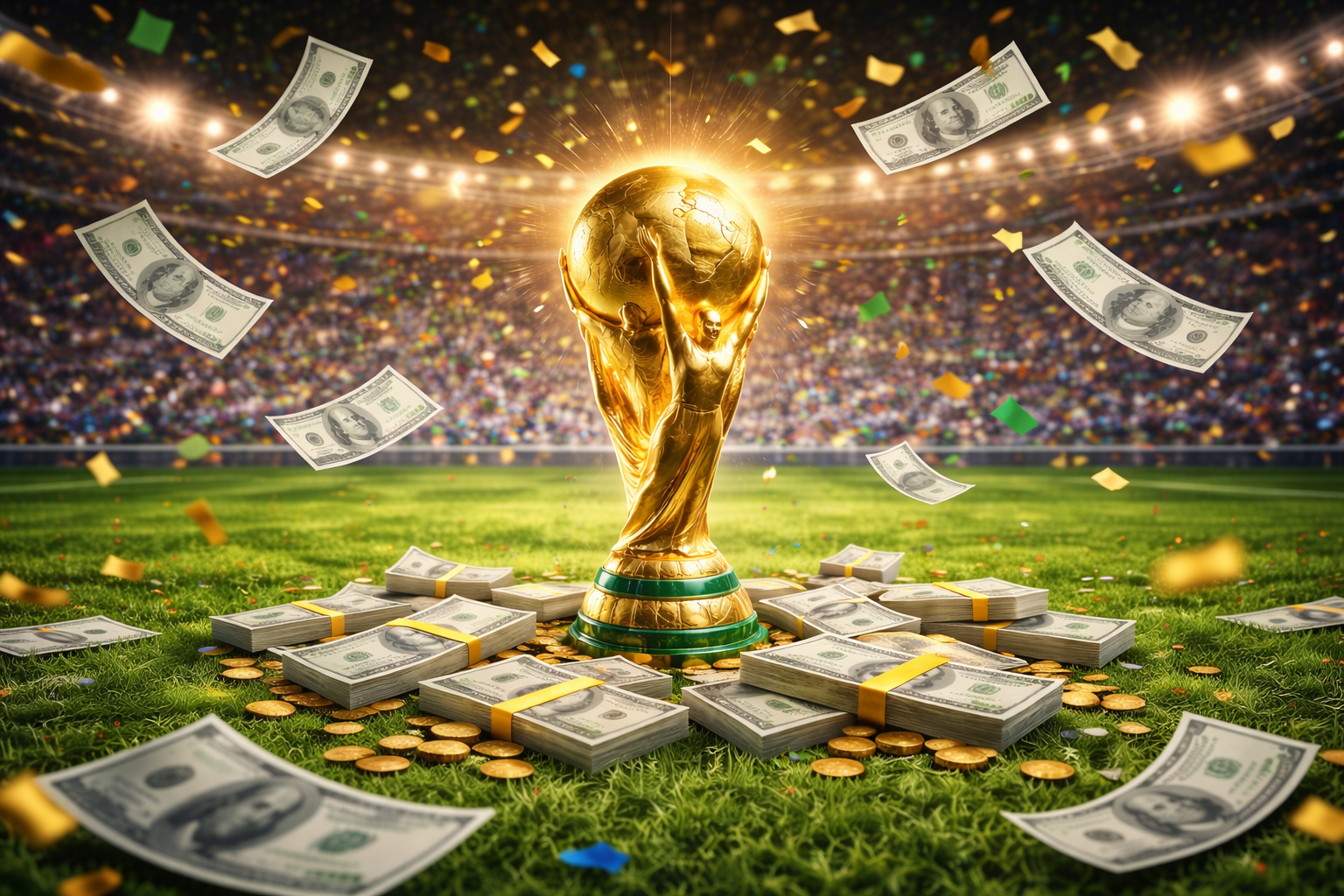
The FIFA World Cup 2026 is set to be the biggest and most commercially powerful edition in football history. Beyond the global prestige, national teams and players will also be competing for record-breaking financial rewards.
With an expanded 48-team format hosted across United States, Mexico, and Canada, the tournament will feature more matches, larger audiences, and significantly increased revenue streams from broadcasting, sponsorships, and global fan engagement. As a result, the prize pool is expected to reach unprecedented levels compared to previous editions.
But for many fans, the real curiosity goes beyond the trophy itself:
- How much money do teams earn for participating and advancing through each stage?
- How is the prize money distributed among federations, squads, and individual players?
In this guide, we’ll break down the expected prize money structure, explain how earnings scale with performance, and show how national teams typically share these rewards with their players. Whether you’re following your country’s journey or simply curious about the business side of football, this breakdown will give you a clear and realistic understanding of what’s at stake financially in the world’s biggest sporting event.
Total Prize Pool: A Record-Breaking Tournament
The FIFA World Cup 2026 is expected to set a new benchmark not only in scale but also in financial rewards. While official figures have not yet been finalized, projections based on recent tournaments provide a strong indication of what teams and federations can expect.
For context:
- 2022 World Cup Prize Pool: Approximately $440 million
- 2026 Projected Prize Pool: Estimated $600 million – $700 million+
This represents a significant increase and would make it the largest prize pool in World Cup history.
Why Is the Prize Pool Increasing?
Several key factors are driving this growth:
- More teams: Expansion from 32 to 48 participating nations
- More matches: A longer tournament with additional fixtures
- Higher broadcasting revenue: Increased global media rights value
- Larger global audience: More viewers across emerging and established football markets
What This Means
With more revenue flowing into the tournament, prize money is not only increasing at the top end, it also benefits a wider pool of teams.
Even teams eliminated in the early stages are expected to earn more than in previous editions, helping federations cover costs and invest further in player development and infrastructure.
In short, the 2026 edition isn’t just bigger in format, it’s bigger financially at every level of competition.
Estimated Prize Money Breakdown by Stage
Here’s a realistic projection of what teams could earn at each stage:
🥇 Winners (Champions)
- $50M – $60M+
The champions will take home the biggest prize ever awarded in World Cup history.
🥈 Runners-Up
- $30M – $40M
Still a massive payout, and often split among federation and players.
🥉 Third Place
- $25M – $30M
Fourth Place
- $20M – $25M
Quarterfinalists
- $12M – $18M
Round of 16 / Round of 32
- $8M – $12M
With the expanded format, more teams will reach knockout stages, meaning more nations cash in.
Group Stage Exit (All 48 Teams Get Paid)
- $3M – $5M minimum
Even the lowest-ranked team leaves with millions, a huge boost for smaller football nations.
How Much Do Players Actually Earn?
Here’s where things get really interesting and a bit more nuanced.
The prize money from the FIFA World Cup 2026 is not paid directly to players. Instead, the funds are distributed to each country’s national football federation, which then decides how much goes to the squad in the form of player bonuses.
Player Bonuses: How It Works
Most federations finalize bonus structures before the tournament begins, setting clear expectations for players. Typical arrangements include:
- Players receive 30% – 50% of the total prize money allocated by their federation
- Progression matters: The deeper a team advances, the higher the bonuses. Teams knocked out early earn smaller payouts, while finalists and winners can see massive sums per player
Example Calculation
Suppose a team wins $50 million in prize money and decides to allocate 40% to the squad:
- Total bonus pool for players: $20 million
- For a 23-player squad, this works out to roughly $500K – $1M+ per player, depending on how the federation chooses to distribute the funds (some players may get slightly more for key roles, like captain or star performers)
Even though the official prize money goes to federations, players are still major beneficiaries. For top teams, a deep run in the 2026 World Cup could result in life-changing earnings, on top of their existing salaries from clubs and endorsements.
This structure also allows federations to reinvest part of the prize money in development programs, facilities, and youth teams, ensuring the tournament benefits football in the country as a whole.
Additional Earnings Beyond Prize Money
The financial impact of the FIFA World Cup 2026 goes far beyond official prize distributions. For both players and teams, the tournament creates multiple additional revenue streams that can significantly increase total earnings.
Sponsorship Bonuses & Endorsements
Top players often earn substantial income through brand partnerships tied to their World Cup visibility. Global stars such as Kylian Mbappé and Lionel Messi have historically benefited from:
- Major endorsement deals with global brands
- Performance-based sponsorship bonuses
- Paid social media campaigns and promotional appearances
A strong World Cup performance can dramatically increase a player’s marketability, leading to new deals and higher-value contracts.
Club Compensation (FIFA Club Benefits Programme)
Clubs are also financially rewarded when their players participate in the tournament through FIFA’s Club Benefits Programme.
- Clubs receive compensation for releasing players to international duty
- Payments are typically calculated per player, per day
- Estimated at $10,000+ per player per day
Over the course of a long tournament, this can add up to significant income for clubs, especially those with multiple international players.
Market Value Boost
One of the most powerful (and often overlooked) financial benefits is the impact on a player’s career trajectory.
A standout performance at the World Cup can:
- Increase a player’s transfer value significantly
- Lead to lucrative contract renewals or transfers
- Elevate relatively unknown players into global recognition
Every World Cup produces breakout stars, and the 2026 edition is expected to do the same, potentially transforming careers in just a few matches.
While prize money is the foundation, the true financial ecosystem of the World Cup includes sponsorships, club compensation, and long-term career growth. For many players, the exposure and opportunities generated during the FIFA World Cup 2026 can outweigh even the direct tournament earnings.
Why Prize Money Matters More Than Ever
The expanded structure of the FIFA World Cup 2026 is changing the financial landscape of international football in a major way. With more teams participating across United States, Mexico, and Canada, the distribution of prize money is broader, and its impact is deeper than ever before.
Financial Impact on Smaller Nations
For many emerging or less-established football nations, World Cup earnings represent a once-in-a-generation opportunity.
- Qualification alone brings significant financial rewards
- Advancing even a single stage can generate substantial additional income
- These funds can exceed the annual budgets of some national federations
For smaller countries, one successful tournament run can fund football development for years.
Investment in Football Development
Federations typically reinvest World Cup earnings into long-term growth, including:
- Youth academies and grassroots programs
- Training facilities and infrastructure upgrades
- Coaching education and technical staff development
- Domestic league improvements
This creates a ripple effect that strengthens national football systems well beyond the tournament itself.
What This Means for 2026
The 2026 edition of the World Cup will do more than determine a global champion, it will reshape the economics of international football.
- More players across multiple squads will become millionaires through bonuses
- National federations will gain funding to accelerate football development
- Every match carries higher financial stakes due to increased prize distribution
In this new era, every victory matters not just for progression in the tournament, but for the financial future of entire football ecosystems.
Because at the FIFA World Cup 2026, every win is more than just a result on the pitch, it’s a step worth millions.
